Warrior Invincible Narrative
A Sports England × Innovation Design Unit service design challenge on disabled youth, representation, and belonging.
Client · Sports England / Innovation Design Unit
Industry · Sport & Public Health
Team · Rashan Mcdonald, Charles Zejia, Li Lel Proctor, Cat Clements, Mingyang Li & Bosky Doshi
My Role · Strategy & Service Design
Methods · Field interviews, LEGO prototyping, street testing
Timeline · 2-day hackathon
Outcome · Winning concept - community service model built & tested in 48 hrs
A two-day hackathon set by Sports England, RCA, and the Innovation Design Unit. Six teams were briefed to find new ways to get disabled young people aged 11–16 more physically active. The stakes were real: 4 in 5 disabled people already want to be active. The system was failing them before they ever showed up.

The barrier wasn't ability. It was never seeing yourself in the game.
The Challenge
Sports England needed not another awareness campaign, but a durable mechanism, something that could convert the intent already present in disabled young people aged 11–16 into sustained physical activity.
The harder constraint: solutions had to work especially for young people from culturally diverse communities, a group doubly underserved by both disability sport and mainstream coaching.


A glimpse of the process
In 48 hours the team ran desk research, spoke to 10 people in the field, and interviewed Helen Derby at Activity Alliance and Andrew Liney, Head of Children & Young People at Sport England. Patterns emerged fast and consistently pointed away from access and toward identity.
The question stopped being "how do we get them there?" and became "why would they ever believe it was for them?"
The insight
Of 264 Team GB Paralympians at Rio 2016, only 20 came from Black, Asian, or other culturally diverse communities. Disabled children learn by imitation, they need role models who share both their disability and their background. The system wasn't just inaccessible. It was invisible to them.

The design response
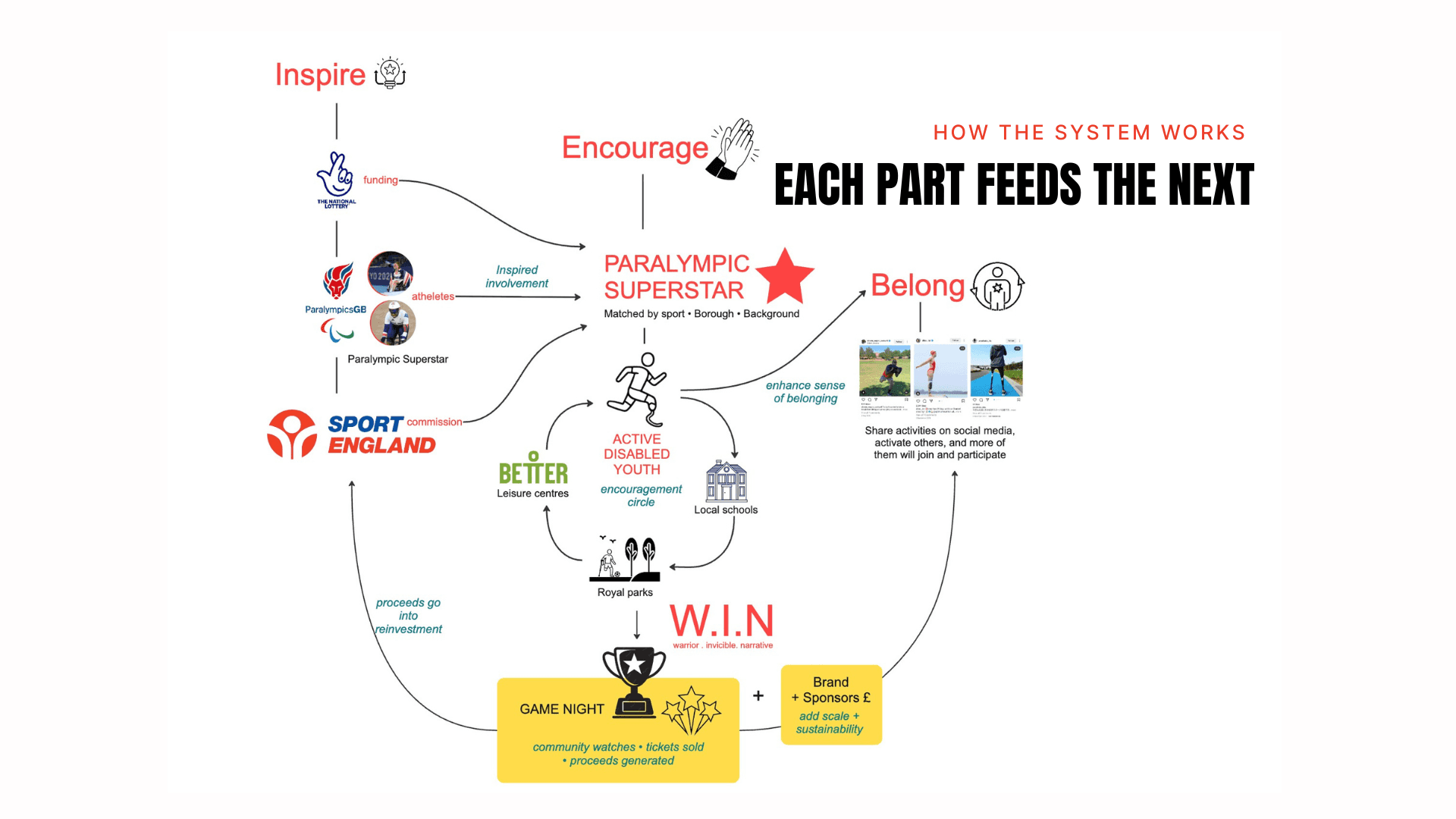
Paralympic Superstar, a community-embedded programme bringing Paralympians into schools and local parks, matched to young people by sport, background, and borough.
The service sustains itself through Game Nights: ticketed community events funded by National Lottery grants and brand partnerships.
A self-reinforcing loop: inspiration in, role models out.

The impact
Concept built, prototyped, and street-tested with 5 members of the public within 48 hours
Positive validation from public testing the proposition resonated immediately
Self-funding model identified - Game Night proceeds + brand sponsorship - removing dependency on recurring grants

Key takeaways
Two days finds the truth. It doesn't test it. Next: one borough, one sport, one cohort.
• Desire was never the barrier. Belonging was. 4 in 5 wanted to be active. The system kept solving the wrong problem.
• Representation is infrastructure. A ramp gets you in. A role model makes you believe it's for you.
• Match beats presence. Same sport, same background, same borough. That's what changes things, not just any Paralympian anywhere.
• Both sides have to gain. The youth get a role model. The Paralympian gets a mission.
• Self-funding is the design. Game Night turns community energy into revenue. No grants. No fragility.

View full case study
A deeper dive into field research, service design system, and funding model
