Thinking Differently
Redesigning retail for minds that work differently
Client · Royal College of Art × Helen Hamlyn Centre for Design
Industry · Inclusive Retail
Team · Bosky & France
My Role · Service Designer, Researcher, Strategist
Methods · Ethnographic research, shadowing, co-creation workshops, service blueprinting
Timeline · 5 months, April 2024 – Aug 2024
Outcome · A neuro-affirming retail toolkit · six interventions across the shopping lifecycle
A research-led service design project at the Royal College of Art, in partnership with the Helen Hamlyn Centre for Design, reframing inclusive retail as a question of dignity, not access.

When shopping feels overwhelming, people don't complain. They leave.
The Challenge
We came to the brief with a question: what does retail look like for the 1 in 7 UK shoppers who are neurodivergent? I chose to focus on adults with hidden sensory needs the customers retailers were losing without ever knowing why. The work had to make shopping accessible and empowering, for everyone, without asking anyone to disclose.


A glimpse of the process
I worked as a sales supervisor at Brora in London for six months to see retail from the staff side. Across the project, we ran 20+ interviews with neurodivergent individuals, shadowed shoppers across Westfield, Harrods and Battersea Power Station, spoke to clinical psychologists, and ran co-creation workshops with the people we were designing for.
Five months in the field, listening with eyes, ears, and a sales lanyard.
The insight
A clinical psychologist gave us the line that reframed everything: "Neurodivergent individuals may hear 10,000 negative comments by adulthood." Shoppers weren't being difficult. They were protecting themselves from a small daily risk of judgement.
Across all our research, the same pattern repeated when shoppers lose control over intensity, pace, or interaction, they leave.
Six ways control breaks and six places to design it back in.

The design response
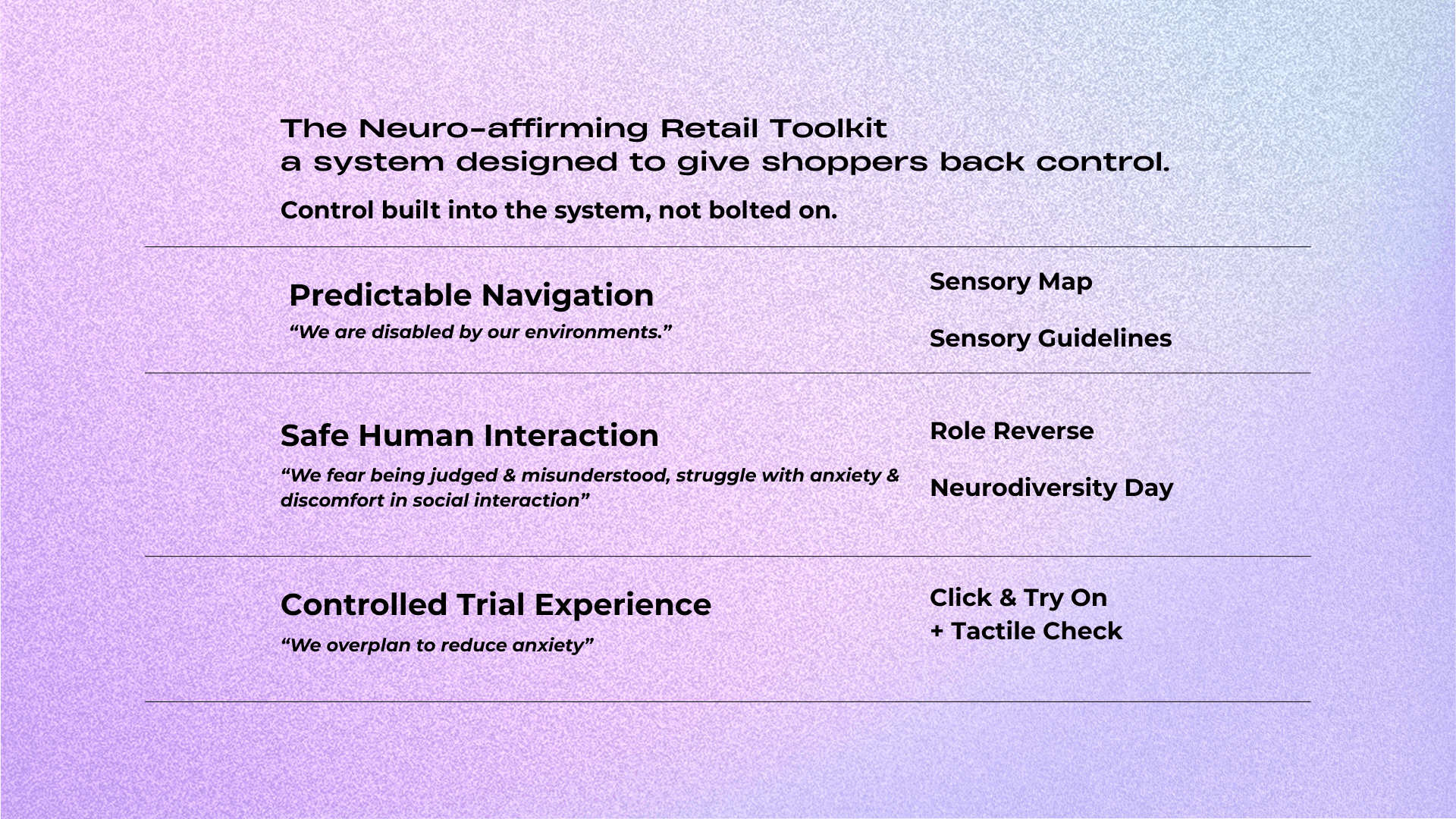
A Neuro-affirming Retail Toolkit. Six interventions organised around three needs: predictable navigation (Sensory Map, Sensory Guidelines), safe human interaction (Role Reversal staff badges, Neurodiversity Day), and controlled trial experience (Tactile Tags, Click & Try On).
Each one designed to give shoppers control without asking them to disclose.

The impact
A complete retail service toolkit six interventions covering the full shopping lifecycle
Validated with neurodivergent participants through co-creation workshops
Mapped to commercial outcomes conversion, basket size, repeat visits, loyalty
A reframe for inclusive retail from add-on accommodations to system-level dignity

Key takeaways
Inclusion isn't only about access. It's about dignity. The strongest moves weren't about adding accommodations, they were about removing the assumptions the system was built on.
Six months working the shop floor taught me more than any interview could have.
If people have to disclose to benefit, the design hasn't gone far enough. If it works for everyone by default, the people who need it most stop having to ask.
A clinical psychologist gave us one line that changed the whole direction. Good research creates those moments.

